
Operations must be secured first.
Deployments, backups, access and acute risks need to be understood before feature work resumes.

Project handover
The supplier is out, the developer resigned, or the agency no longer exists. The system keeps running and keeps earning money, but nobody dares touch it. I take such projects on: first an assessment that tells you where you stand, then step by step back into a state where changes are plannable again.
No subscription, no minimum spend. The entry point is a fixed price assessment, after that by effort or as a scoped project, whichever fits better. Also for systems without documentation and without the people who built them.
Remote from Germany. Straight with me, no agency in between.
The starting point
A system that has been running for years carries decisions nobody can explain any more. Why one place rounds the way it does. Why an order gets written twice. Why that one cron job has to run at three and not at four. The code says what happens, not why, and the person who knew is no longer there.
That is why the first step is not a rebuild but understanding. What does the system actually do today, which quirks does it have, and which of them is somebody relying on without knowing it. Cutting corners here means building the first change on an assumption, and the bill arrives in production.
The second part sits outside the code: where the system runs, who holds the access, how a change gets out, and what happens if the server fails tomorrow. On projects taken over, that is regularly the more urgent part.
Does any of this sound familiar?Who this is for
For managing directors, CTOs and product owners after a developer or supplier leaves. The system still runs, but knowledge, access and risks are not sufficiently documented.
Deployments, backups, access and acute risks need to be understood before feature work resumes.
Repositories, hosting and accounts can legally be transferred even if documentation is missing.
The assessment must show what is urgent, what can wait and how ownership should continue.
What I do
Static analysis across the whole codebase, plus the dependencies, the runtime and the path a change takes to get out. The result is not a grade but a list: what the system does, what is a risk, roughly what fixing it costs. That lets you decide, including against me.
Before anything else, the question whether you can act in an emergency: who has access to server, domain, database and repository, do backups exist, and has one ever been restored. On projects taken over this is regularly the largest gap, and the cheapest one to close.
Where no tests exist, characterization tests come first: they record what the system does today, regardless of whether it is right. The net does not have to be complete, it covers the paths that money hangs on. After that the first change is no longer a jump in the dark.
A PHP version without security updates, a package with a known hole, an account a former colleague still has. Such items come before any further development, and they come one at a time: each step goes live on its own and can be reversed on its own.
Only then the thing you actually called about: new features, a rebuild, an integration. The difference is that a net is in place now and someone can say what a change will set off.
The goal is not that you need me. What comes out belongs to you: the tests, the documentation, the pipeline. When your team takes over or a new developer arrives, the handover is a meeting, not a project.
Is your system running without anyone who understands it?
Send me the key details. You get an assessment of what a handover would mean for you, before you commission anything.
How it runs
Four steps, and after the second you know what you are getting into. No step assumes you commission the next one.
What kind of system is it, how long has it run without care, what hurts most right now. After that I tell you whether I am the right person. If I am not, I say so.
Read access to the repository and to operations is enough. The result is a list with risks, effort and an order, plus an hour to go through it. Then you decide.
Access, backups, security updates, a test net around the critical paths. Rolled out one at a time, each step with a way back.
From here it is about your plans. Or about a handover to your team, once you have someone again. Both are valid outcomes.
The other side
The total is not printed below, because I do not know it. I do know the items, and in almost every case two of them already add up to a multiple of what the entry package costs. Do the maths yourself, then the number is yours.
The entry package below costs less than a single working day of standstill in most companies. It replaces none of these figures, but it makes them provable for the first time.
Entry offer
Fixed price. Everything after that is quoted by scope, before it starts.
Not a report but a state: after a week you know where your system sits, who has access to it, and that a backup actually works. One acute item is fixed along the way. That holds even if you decide against me afterwards.
What you get
What you do not get
The outcome
Instead of an uneasy feeling, a list: what the system does, what is a risk, what fixing it costs. That is also the basis for deciding about a rebuild at all.
Access inventoried, backups tested, a recovery that has been rehearsed once. That is the part that costs nothing and saves everything.
With a test net and a traceable path to production, a change is a task with a date again instead of a bet.
What comes out belongs to you and is written down. The next developer needs days to get up to speed, not months.
Technologies I use
Evidence
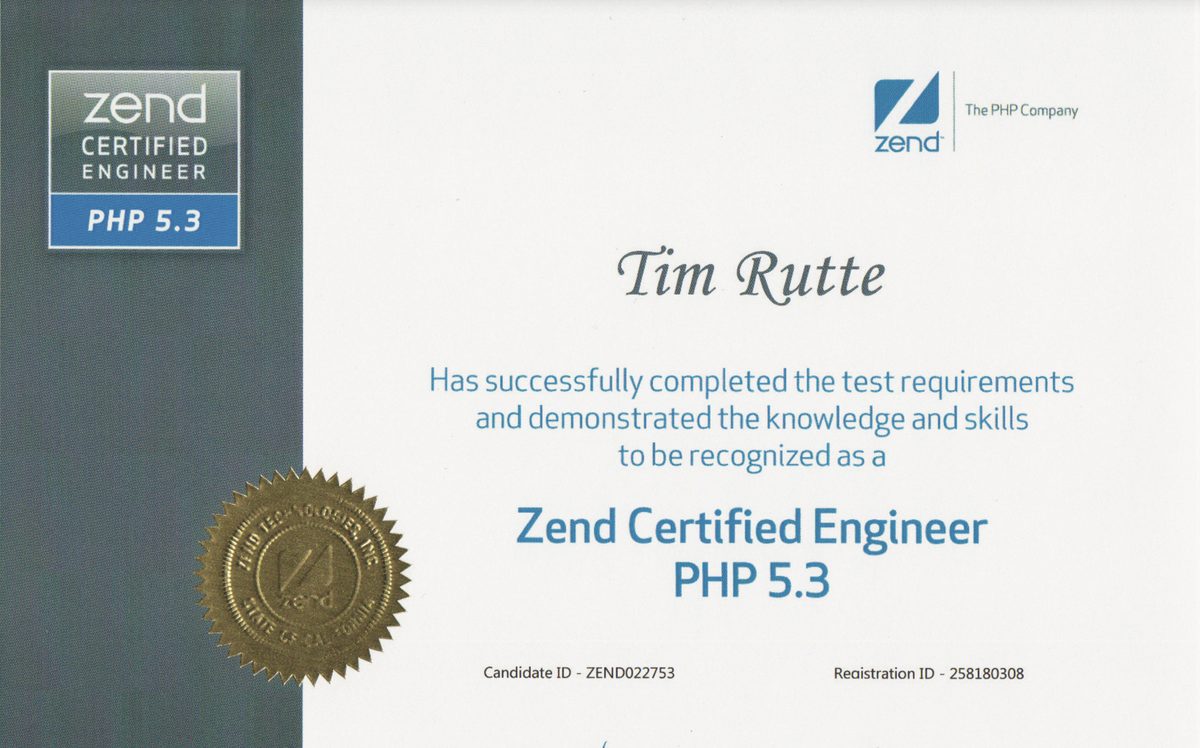
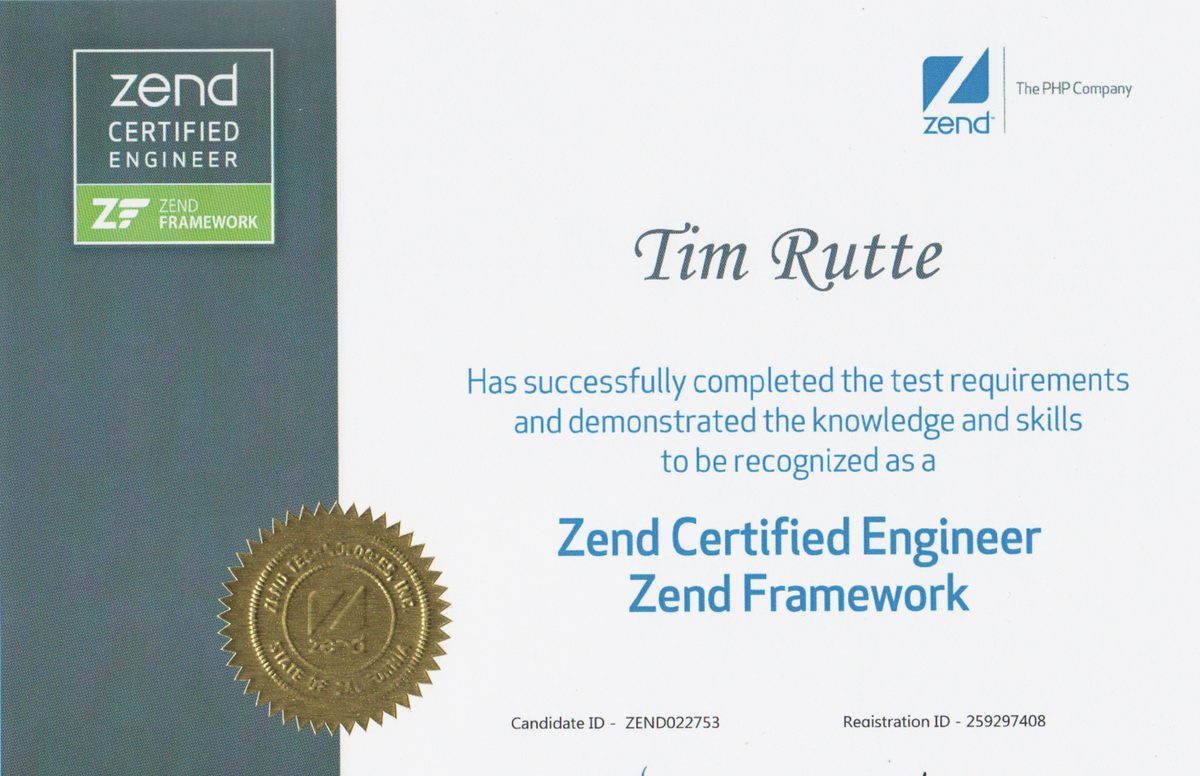
Most suppliers know the destination. With an old system, what decides the outcome is whether someone also knows the starting point: why a passage is written the way it is, and what replacing it sets off. Zend Technologies no longer exists under that name, and neither do the exams of the time. For the database side there is an Oracle certification on MySQL 5, because that is where the quieter traps sit: character sets, collations and a strict mode that starts refusing what used to pass.
From practice
Grown legacy code for the revenue reporting of a global AdTech platform, taken over by a team that had not written it. First a safety net and infrastructure as code, then step by step replacement while the business kept running.
Read the case studyAlso from real projects
The order of the first week and the reasoning behind it: why access, the deployment path and a tested restore come before the code, and what I deliberately leave alone during that week.
Read the articleThe planned assessment rather than the emergency: the order of work across five days, the commands that produce the findings, and what ends up in the report when somebody wants to buy or inherit a system.
Read the article
Who you are talking to
I am Tim Rutte. More than 20 years in software development, and I regularly take on systems whose developers are gone. You talk to the person who touches your code, from the first call to the handover.
Common questions
That is the normal case, not the exception. It is exactly why the assessment comes first: it reconstructs from code, database and operations what the system does. Whatever cannot be settled that way goes on the list as an open question instead of disappearing into an assumption.
The entry package costs 950 euros net at a fixed price and tells you what everything else costs. Without it any number is guessed: two applications with the same line count can be a factor of ten apart, depending on whether the dependencies are maintained and whether tests exist. After that I work by effort or as a scoped fixed price project, whichever fits better.
Yes, but without a subscription and without a minimum spend. There are months with nothing to do, and those should cost nothing. What I commit to is being reachable in an incident and a response time agreed beforehand.
Sometimes it would, but that decision can only be made once what exists has a number on it. A rebuild has to do everything the old system does, including the quirks nobody documented and somebody relies on anyway. That is why the assessment comes before the question, not after it. Why rewrites fail so often is something I have written up in an article.
For the conversation usually within a few days, for the assessment one to two weeks later depending on load. If something is burning, because the system is down or a hole is open, say so in the first sentence. Then I sort differently.
If they are reachable, an hour of handover is the best thing that can happen to you, and I ask specifically about the things that are not in the code. If they are not reachable, nothing changes about the approach. It takes longer, and the assessment carries more weight.
Yes, and that is part of the assessment. At the end there should be a list on your side of who has access to what, which contracts sit behind it, and what happens if I am gone tomorrow. Accounts belonging to a former colleague go on the same list.
Yes, it is often the first urgent item after the assessment. It is a project of its own with its own order and its own way back, and it has a dedicated page on PHP upgrades with the details.
Other services
Modernizing grown systems step by step: strangler fig instead of a rewrite, operations untouched, every step reversible.
Learn moreFrom PHP 5.6, 7 or early 8 to a supported version, while everything keeps running: compatibility assessment, a test net, automated rewriting, staged rollout.
Learn moreBackends for SaaS and platforms that hold under real load: Go and PHP 8, event-driven, with tenant isolation and recovery designed in.
Learn more